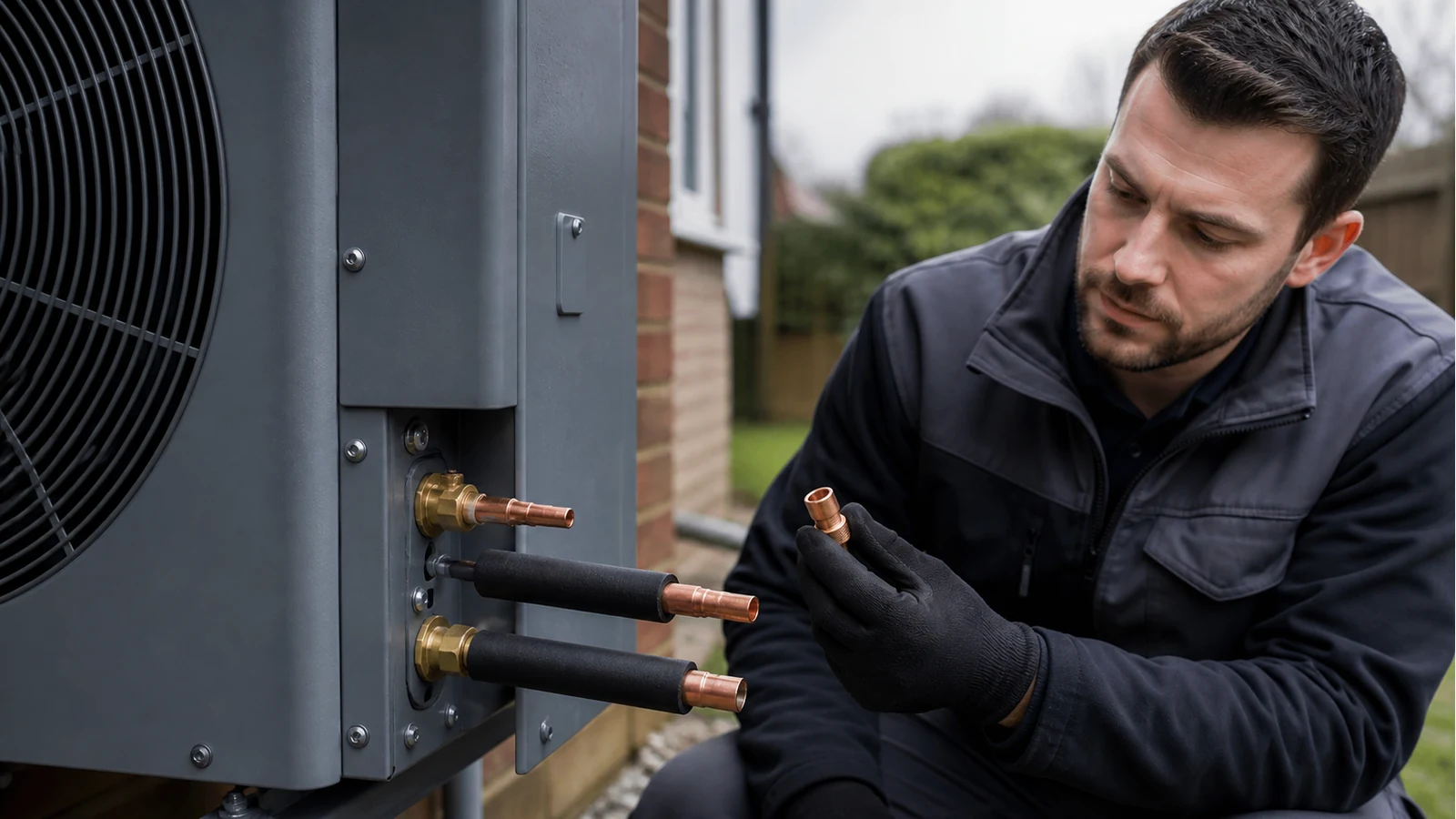
Heat Pump Refrigerant Flare Joints Uk Guide
Short answer: a heat-pump refrigerant flare joint is only a sensible next step when the manufacturer specifies that connection, the pipe and fitting are matched and undamaged, and the work is within the responsible person's competence and commissioning procedure. Tightening by feel—or using a generic torque figure from the internet—is not a safe substitute.
This guide is a decision and inspection aid, not an alternative to the installation manual. It helps you identify the hold points before joining a flare; it does not tell you which refrigerant, oil, torque, pressure-test method or commissioning sequence applies to a particular heat pump.
Start with the connection type, not the tool
First establish the exact outdoor unit, indoor unit, refrigerant and pipe specification. Some systems use flare connections at particular points; others require different methods or impose model-specific materials and procedures. If the documentation does not call for a flare at the connection you are looking at, do not create one simply because the tube and nut appear to fit.
Then check the physical match: stated outside diameter, correct nut, clean mating seat, sound tube, and a route that lets the connection align without pulling the pipe into place. A correctly formed flare cannot compensate for a damaged fitting, a twisted pipe or a joint held under strain.
Safe to proceed, or stop and escalate?
| Proceed only when all are true | Stop and escalate when any apply |
|---|---|
| The unit manual specifies the connection and gives the required materials and tightening method. | The model, refrigerant, connection type or torque specification is unknown. |
| The tube end is square, deburred, round, clean and free from cracks or deep marks. | The flare, nut, fitting seat or tube is damaged, contaminated or previously mishandled. |
| The pipe and nut can be aligned and started by hand without side-load. | The pipe must be pulled, bent sharply or forced to start the threads. |
| The final installation, test and commissioning responsibility is clear. | The sealed circuit is open and the responsible qualified person or procedure is not available. |
Prepare the flare before the wrench appears
- Cut the tube squarely with the suitable cutter for the specified tube.
- Remove burrs without allowing swarf into the pipe.
- Fit the required nut before flaring.
- Form and inspect the flare: reject it if the surface is cracked, scored, uneven or out of round.
- Bring the two sides together squarely and start the nut by hand. If it will not start easily, stop rather than chasing the thread with a wrench.
For a worked example of this sequence on one current product range, see the Daikin installer reference guide for its covered R32 split-system range. It calls for a square cut, downward deburring, inspection of a flawless and evenly circular flare, and the manufacturer-specified two-wrench tightening method. Use your heat pump's own manual as the controlling document.
Torque protects the joint; it does not prove the circuit
When the equipment instructions call for a flare nut, use the stated torque, an appropriate torque wrench and a backup spanner as specified. That reduces the temptation to solve an alignment or flare-quality problem with extra force. It does not replace the prescribed leak test, evacuation, charging or commissioning steps. For the pre-tightening checks, use the torque-wrench flare-nut checklist.
Competence is part of the connection decision
For stationary refrigeration, air-conditioning and heat-pump equipment containing F gas, the current GOV.UK qualifications guidance for F-gas work identifies installation, service, maintenance and leak checking among the activities requiring the appropriate individual qualification. Apply that scope to the actual work, not just to the moment a spanner touches the nut.
Tool selection is a conditional next step
If the equipment documentation specifies a flare connection and you have confirmed the tube size and work scope, the current flaring-kit details can help you check whether a kit is relevant. A tool is relevant for making a correctly specified flare; it is not a substitute for the unit procedure or qualified commissioning.